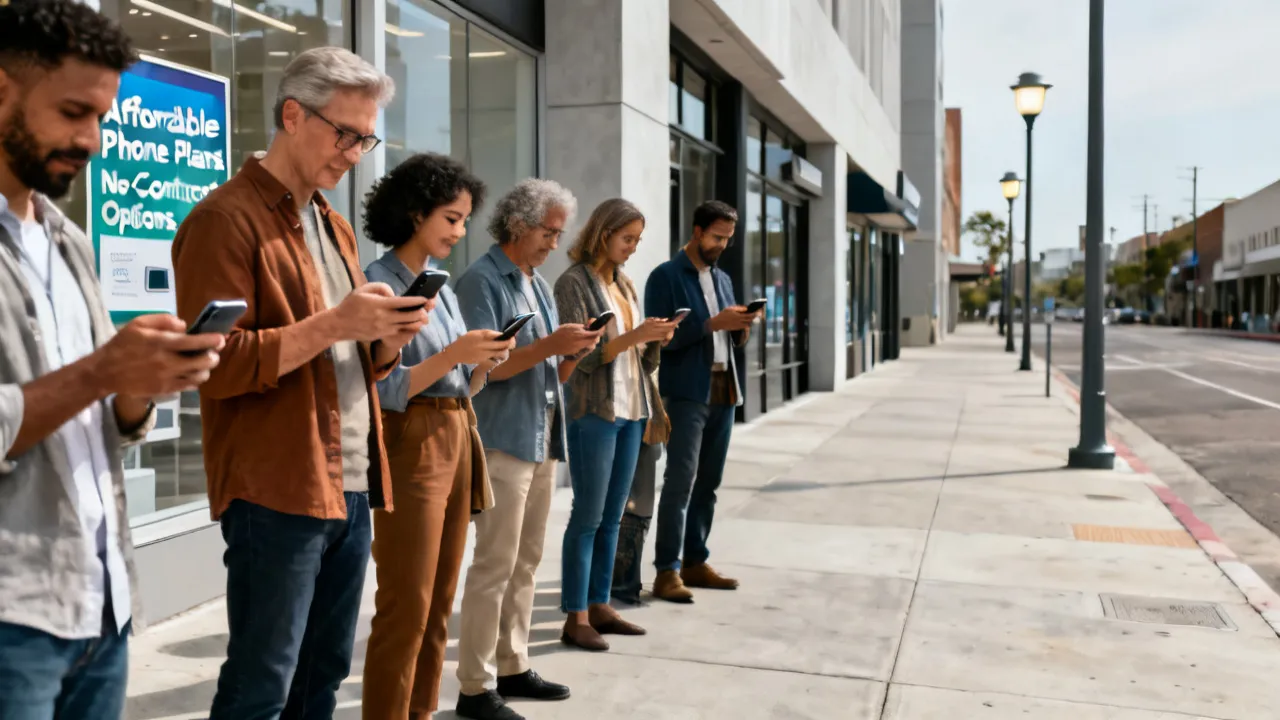

Phone Plans Without Contracts: No-Contract Options Guide
This guide explains Cell Phones Services Without Contracts, showing how government-supported phone programs can help eligible households obtain service through providers such as SafeLink Wireless, Assurance Wireless, StandUp Wireless, Access Wireless, True Wireless, and others. It also compares plan basics, details eligibility and application steps, and provides expert insights on practical trade-offs like device upgrades, data speed limits, and service reliability.

Quick Guidance: How Contract-Affordable Cell Phone Service Works
If you’re looking for Cell Phones Services Without Contracts, the very practical path is usually to combine two ideas: (1) contract-affordable commercial wireless plans (often month-to-month) and (2) government-supported phone programs administered by eligible providers. In both cases, the “no-contract” benefit typically means you avoid good commitments, while the plan value may depend on device eligibility, data speed tiers, and optional add-ons.
From an industry perspective, contract-affordable wireless options can be a strong fit for people who want flexibility—such as changing usage patterns, moving residences, or managing monthly budgets. However, you should evaluate network performance, data thresholds, and activation and documentation requirements before choosing a provider.
To make the decision feel less confusing, it helps to recognize that “no contract” can come from at least three different directions: (a) true month-to-month plans from commercial carriers/retailers, (b) bring-your-own-device (BYOD) approaches where you avoid device installment lock-ins, and (c) government or benefit-linked programs that replace the contract structure with eligibility verification. Each route has its own rules, expectations, and potential trade-offs.
What Counts as “No-Contract” in Wireless Services?
“No-contract” generally means you are not signing a multi-year agreement. That usually results in one or more of the following structures:
- Month-to-month service (you can cancel with minimal commitment)
- Simple upfront device purchase or bring-your-own-device (BYOD)
- Service funded through eligibility-based programs where enrollment replaces a traditional contract term
When government-supported programs apply, the arrangement is still not a typical consumer contract. Instead, eligibility is confirmed periodically, and the provider supplies service and sometimes a device, subject to program rules.
It’s also worth noting what “no contract” doesn’t always mean. Depending on the plan, you might still face a device balance (if you buy a phone with financing), or you might face certain “early termination”-like fees for features you opt into. In addition, some plans advertise “no contract” but still require activation under specific terms, such as a minimum service period to qualify for a promotional device. So, the real question is not only whether there is a contract, but whether there are conditions that affect cost or flexibility.
Another common misunderstanding is that “no contract” automatically means “no verification.” Commercial month-to-month plans may still require identity checks and a credit or account verification process. Benefit-linked programs require documentation. So “no contract” is mainly about commitment length and pricing structure, not about paperwork disappearing entirely.
Government Phone Programs: Why They Matter for Contract-Affordable Service
In practice, government-supported phone plans are often the very accessible way to obtain contract-affordable service with mainstream capabilities such as voice, texting, and defined data allowances. The providers commonly participate in national programs designed for low-income households and qualifying participants in assistance programs.
Key takeaways for applicants:
- Service availability and exact features vary by plan and state or region.
- Device offers may depend on eligibility verification and stock/supply at enrollment time.
- High-speed data, device upgrades, and premium features may involve optional costs.
Government phone programs can be particularly valuable because they can lower the barrier to entry. For people who have trouble qualifying for traditional plans due to budgeting pressures, benefit-linked service can make it possible to keep a reliable communications line without a long-term agreement. In many cases, a low-cost or discounted smartphone is possible, and that can remove the need to pay full retail pricing for a new phone up front.
However, the “value” of these programs can be nuanced. A plan might include unlimited talk and text but provide limited high-speed data. Many users find that their daily needs—maps navigation, short video clips, messaging apps, and web browsing—are workable, but heavy streaming can slow down after a threshold. So the key is aligning your expectations with how the plan is engineered.
Also, government-supported programs tend to focus on essential mobile connectivity. That doesn’t mean they are “basic,” but it does mean you should pay attention to what is included and what might be optional. Some users get premium features only if they add them. Others may get only certain data tiers. And some plans might not include the same level of device upgrade frequency as commercial “upgrade every year” offers.
Expert Comparison: Providers Commonly Used for Government-Supported Service
Below is a comparison of providers that offer government-supported phone plans through their programs. Even though the broader framework is similar, the specific plan structure and optional upgrades can differ.
| Provider (Official Plan Page) | What the Government-Supported Plan Typically Includes | Potential Additional Package Costs |
|---|---|---|
| SafeLink Wireless | Eligible customers may receive a affordable smartphone or use a bring-your-own-device option; unlimited text and calls and data allowances that vary by plan and state. | Premium device upgrades and additional data (when offered) may incur costs. |
| Assurance Wireless | Eligible customers may receive a affordable Android smartphone; unlimited talk and text; data allowances are provided under the program. | Optional upgrades such as higher high-speed data or international calling services may have extra fees. |
| StandUp Wireless | Eligible customers may choose a affordable smartphone or BYOD; unlimited talk and text; data plans are provided. | Premium phone upgrades or extra data may be available for a fee. |
| Access Wireless | Unlimited voice and text with limited high-speed data through program benefits; data boosts and related features may vary. | Data boosts and device upgrades may involve additional charges. |
| True Wireless | Government-supported phones and plans may include voice and data service when eligibility is confirmed. | Optional improvements to better devices and additional data plans may require added costs. |
Source of the above information: See the providers’ official pages immediately below.
SafeLink Wireless: https://www.safelinkwireless.com
Assurance Wireless: https://www.assurancewireless.com
StandUp Wireless: https://standupwireless.com/
Access Wireless: https://www.accesswireless.com
True Wireless: https://www.gotruewireless.com/
(This section reflects the providers’ publicly described offerings, summarized for comparison.)
Eligibility Requirements and How to Apply (Step-by-Step)
Government-supported phone programs typically use household income thresholds and/or participation in qualifying assistance programs. Below is a structured overview based on commonly cited program rules.
1) Eligibility Conditions (Typical Program Framework)
- Income thresholds: Eligibility is often tied to household income relative to federal poverty guidelines (for example, Lifeline is commonly described at or below 135% of the federal poverty guideline; ACP is commonly described at around 200%—exact figures can vary by program rules and updates).
- Assistance-program participation: Applicants may qualify through participation in programs such as Medicaid, SNAP, SSI, or other eligible programs recognized by the program administrators.
- Tribal lands (where applicable): Additional benefits may be available for eligible residents on qualifying tribal lands.
Because eligibility rules can change over time—sometimes with updated thresholds, new qualifying assistance programs, or modified documentation standards—you should rely on the latest provider and program guidance for the most accurate details. The purpose of this “typical framework” is to prepare you for what you will likely be asked to show, not to replace the provider’s official checklist.
In real life, one of the biggest causes of delays is not whether someone is eligible, but whether the household information and documentation match what the provider verifies. A name mismatch, a wrong address line number, a document that is too outdated, or a household count that was misinterpreted can slow or stop approval. So it’s helpful to approach the process like an accuracy task, not only a financial qualification task.
2) How to Apply (Common Process Across Providers)
While each provider has its own application interface, the flow is typically similar:
- Choose a provider that supports the relevant government program in your area.
- Check your eligibility using the provider’s criteria (often based on income or qualifying program participation).
- Complete the online application on the provider’s website (very providers use web forms).
- Prepare required documentation (commonly proof of program participation or income documentation, plus identity and address information—requirements vary).
- Upload or submit documents as prompted (some providers perform verification through official systems).
- Await confirmation after verification is completed.
- Set up service once approved: activate your line, and if receiving a device, follow the device setup instructions.
Some applicants are surprised by step six (activation) because approval can happen before you fully receive service. Activation might require additional steps like confirming the device number (IMEI or SIM association), completing online account setup, or verifying an address for shipping. If you’re planning around a move or a job start date, you should build a small buffer so you don’t end up without a functioning line during the transition.
3) Application Methods You May Encounter
Depending on the provider, you may see different verification approaches, such as using a national verifier for Lifeline eligibility, or directly uploading documentation through the provider’s portal. Expect to be asked for proof that you meet the program conditions. Accuracy matters: mismatched names, addresses, or documentation dates can slow approvals.
It can help to understand the “why” behind verification. Programs designed to reduce poverty-related communication gaps must ensure funds go to eligible participants. Providers are audited and must keep accurate records. That’s why they may verify through automated systems or require uploaded documents. Even if the program is meant to be accessible, the compliance requirements add process steps.
Another important detail is that verification can sometimes take longer if you submit at a time when the system is experiencing high volume, or if the submitted documents are difficult to read. If you’re uploading photos or scans, use a clear image with full visibility of the document’s key sections. If you’re photographing paper, avoid glare and make sure the corners are fully included. This is one of the simplest practical changes you can make to improve approval odds.
Eligibility Requirements Checklist (Practical, Expert-Style)
Before starting an application, assemble the likely documents and information you will need. This is a common reason applicants lose time—not because they are ineligible, but because submissions are incomplete.
- Valid identification details (as required by the provider)
- Current address information
- Proof of participation in eligible programs or income documentation
- For BYOD: device compatibility information (model, unlocked status, etc.)
To expand on the checklist in a way that reduces confusion, consider that identity and address information often needs to match consistently across your application. If you recently moved, you may need to submit address documents tied to the new residence. Some people attempt to use old address information because they still have an ID showing the previous address; this can create verification friction if the provider expects current address proof.
For BYOD, device compatibility can be more than just “is it unlocked.” Many providers require the device to support specific network bands or to be configured for activation with their system. Even if a phone is unlocked for one carrier, it might not fully support the required bands for another network. That’s why you should check the provider’s device requirements, and if possible, use a phone that the provider explicitly lists as compatible or that meets their stated minimum requirements.
How to Choose Between Providers for No-Contract Service
When comparing Cell Phones Services Without Contracts delivered through government-supported channels, an “apples-to-apples” comparison is tricky because the offers can include different device options and data tiers. Still, you can evaluate providers using a consistent set of criteria.
1) Decide: Device Needed or BYOD?
- If you need a smartphone: choose a provider offering a affordable device through the program (availability can vary).
- If you already own a device: consider BYOD options and check compatibility and activation steps before you apply.
Choosing between “program device” and BYOD is not only a cost decision—it’s also a risk and time decision. Program devices might require shipping time, inventory availability, and setup guidance. BYOD avoids waiting for a device shipment (assuming your line is approved and activation proceeds smoothly), but introduces the risk that your device is incompatible with the network requirements. If you have only one phone and you can’t risk losing service during activation attempts, you may prefer program-device enrollment or confirm compatibility before committing to BYOD.
2) Review Data Characteristics Carefully
Many program-supported plans include limited high-speed data. After thresholds, speeds may reduce, which can affect video streaming, navigation, and app updates. As an industry top practice, treat the data allowance as a “usage budget” rather than assuming unlimited high-speed performance.
Data can be consumed faster than people expect, especially if you rely on mobile data for tasks like:
- Video streaming (even “short” clips can add up)
- Video calls and conferencing apps
- Regular navigation map downloads and live traffic updates
- Software updates and app downloads
- Backups to cloud services and large photo sync operations
When you understand how your phone usage maps to data consumption, you can choose a plan that feels more “stable.” If you mainly need messaging, calls, and light browsing, a limited high-speed bucket with slower remaining data may still work well. If you stream content frequently, you might need to plan for additional data boosts or consider a different plan tier.
3) Verify Optional Upgrades and Associated Fees
While the core plan may be covered through benefits, some providers list optional upgrades. Examples include:
- Premium device upgrades
- Additional or faster data options
- International calling add-ons
If you anticipate high usage, ask how upgrades are structured to avoid surprise charges.
Optional upgrades often have a specific billing mechanism. For instance, some add-ons might be daily, weekly, or monthly; some might be one-time “data boost” purchases. If you don’t understand the billing cadence, it’s easy to misinterpret how quickly charges could add up. So you should look for the unit of measurement (data amount), the frequency (one-time vs recurring), and the price. A useful approach is to write down the upgrade pricing in a notes app or print it (if available) so you can refer back later before purchasing add-ons.
4) Check Activation Timeline Expectations
Providers generally require eligibility verification and may take time to process applications, mail devices (if applicable), and activate service. Plan for interim communication needs during the transition.
Activation timeline expectations can be influenced by factors like:
- How quickly documentation is verified
- Whether you select BYOD or request a program device
- Shipping delays if a phone must be mailed
- Network provisioning time after approval
- Your availability to complete final setup steps (SIM insertion, account login, PIN setup)
If you are transitioning from an existing carrier, you might need to transfer your number (porting) or set up a new number. Number porting can introduce additional steps and sometimes additional time. If keeping your existing number is important (for job applications, school, medical records, or two-factor authentication), consider starting the switch early and keeping your current phone active until the new line is working. Many switching problems are solved by “don’t cancel the old line too soon.”
5) Consider Network Coverage and Experience
Even when plans are “similar,” actual performance depends on which network your provider uses in your area. Before committing, confirm coverage expectations for your nearby home, workplace, school, and commuting routes. If you can, test data performance using a trial-like approach or by checking community feedback tied to your region (while treating anecdotal claims carefully).
Network performance isn’t just about whether “service exists.” In practice, experience changes based on:
- Signal quality inside buildings (apartments, basements, offices)
- Time-of-day congestion (even in areas with coverage)
- Weather and seasonal impacts
- Your phone’s supported bands and capabilities
- Whether the plan prioritizes data in a certain way (priority policies can vary)
One practical recommendation is to check coverage maps and also ask people you trust about real-world performance in the exact locations that matter to you. Coverage at a general map level can be misleading; performance might differ block to block. If you have a friend or family member on the same provider network, you can even do a quick test: check load time for a map route, try opening a common website, and see how well video or audio works. Use that information as a decision input, not as a guarantee.
Month-to-Month Alternatives vs. Government-Supported Contract-Affordable Service
Not everyone qualifies for government-supported programs. If you fall outside eligibility, contract-affordable wireless can still exist through month-to-month options. The trade-offs you might face include:
- Higher monthly cost compared with eligibility-based benefits
- Possible device installment requirements depending on the retailer
- More frequent plan changes in competitive no-contract markets
Nevertheless, for many consumers, contract-affordable commercial service offers valuable flexibility. The “top” route depends on your eligibility, device situation, and monthly usage pattern.
It’s also helpful to distinguish “no contract” from “no commitment.” Month-to-month plans can still have promotions and conditions. For example, a retailer might require you to keep the plan for a certain period to maintain a promotional price, or a phone financing deal might require payment to avoid repossession. So even though you can cancel monthly service, you may want to evaluate the full cost picture—including device cost and any fees that apply during cancellation.
On the other hand, government-supported plans can offer very strong monthly savings, but they are usually tied to ongoing eligibility. That means if eligibility ends (for example, if your income rises above the threshold), your plan might change or end after a re-verification cycle. So it’s worth understanding what happens if you lose eligibility: will there be a transition period, will the provider notify you, and what will your new billing be?
Common Questions (FAQs)
FAQ 1: Are contract-affordable phone services the same as government phone programs?
No. “No-contract” is a billing structure that means you avoid a good commitment. Government-supported plans are typically eligibility-based and may replace the contract requirement, but they still require verification and periodic re-checks under program rules.
Think of it this way: “no contract” tells you how long you’re committed to the service agreement. “government phone programs” tells you who qualifies and how the discount is funded. In many cases, you can experience both at once (no contract plus government support), but they are separate concepts.
FAQ 2: Do these providers always offer a affordable smartphone?
Many program descriptions indicate a affordable smartphone option for eligible customers, but availability can vary by plan, region, and device inventory. Some applicants may choose BYOD depending on program rules.
Availability can be impacted by supply chain and device refresh cycles. As a result, your smartphone offer might differ from what you see on a provider website at one moment. If receiving a device is important, it can be wise to confirm what models are available at the time you apply and whether the provider guarantees a device or offers a choice among available models.
FAQ 3: What happens to high-speed data after the allowance is used?
For many program-supported plans with limited high-speed data, speeds may reduce after the included threshold. This can affect streaming and large downloads. Review the plan description for the very accurate speed and threshold details.
Some plans might also apply throttling (slower speeds) rather than complete “data stop.” Others may offer a limited amount of additional data through optional “boosts.” Your best strategy is to find out the exact mechanics: Does data slow automatically? Is there a hard cap? Do streaming services experience different behavior? A clear plan description will provide these details.
FAQ 4: How long does it take to apply and start service?
Timelines differ based on verification complexity and application completeness. The very common delays come from missing documents or mismatched information. Submitting a complete application typically reduces turnaround time.
In practice, many applicants experience a two-phase process: (1) eligibility verification and (2) device/line activation. If you are coordinating multiple events—moving, school enrollment, work start dates—consider keeping a backup communication method if possible (for example, Wi-Fi calling, a temporary SIM if offered, or keeping your previous service active while activation completes).
FAQ 5: Can I keep my existing phone if I use BYOD?
Often, BYOD is possible, but device compatibility and activation rules apply. You should confirm that your device is unlocked and supported for activation before relying on BYOD.
Also, check whether your phone is compatible with the provider’s network technology (for example, certain devices might require specific settings). Even when phones are unlocked, they can be “carrier locked” in a functional sense (e.g., network provisioning issues). Confirming compatibility reduces activation failures.
FAQ 6: Are there hidden costs?
Core plan features are generally tied to the program benefits, while optional upgrades—such as premium devices, additional data, or international calling—may involve fees. Always review the provider’s upgrade pricing and terms before selecting add-ons.
“Hidden costs” is often a misunderstanding. Sometimes charges are fully disclosed, but not clearly understood. Examples include activation fees (less common for program enrollment), device-related fees, shipping charges for replacements, or costs for add-ons. A good approach is to review the pricing page and note which features are included and which require purchase.
FAQ 7: Will I definitely receive a government-supported phone?
No. Approval depends on meeting eligibility requirements and successfully completing the application and verification steps. Some applicants may be denied due to documentation issues, household qualification errors, or other program constraints.
Even eligible applicants can be delayed if the submitted documents are incomplete. If you receive a denial or a request for more information, review the reason carefully and resubmit promptly with corrected details. Many programs allow you to fix errors rather than treat the first attempt as final—so keep your documentation organized and follow the provider’s instructions.
Industry Expert Perspective: Common Mistakes to Avoid
- Starting without documentation—you may need proof of eligibility to complete the process.
- Choosing a provider solely on “affordable device” messaging—coverage and data behavior often matter more day-to-day.
- Ignoring upgrade options—optional fees can become relevant if your usage grows.
- Assuming unlimited high-speed data—many plans include defined high-speed allowances.
If you approach selection methodically—eligibility first, then device needs, then data and network—you’re more likely to end up with service that matches real-world usage.
Here are additional mistakes that can be easy to overlook:
- Using inaccurate household information: If you misreport the household members count or income, it can affect eligibility verification.
- Submitting blurry uploads: A document image that cannot be read can trigger delays.
- Waiting too long to switch numbers: If porting is involved, starting early helps avoid losing service during transitions.
- Not verifying BYOD compatibility: A device that is “unlocked” may still not activate if it lacks certain supported configurations.
- Not testing coverage before you rely on the phone: If you depend on mobile data at work or school, confirm performance in those exact locations.
Finally, keep in mind that “no contract” can make it easier to switch providers, but that doesn’t mean switching is instantaneous. Activation, porting, and device setup require time. Plan your switch around your schedule and minimize high-stakes dependence until everything is stable.
Reference Links (for Further Review)
For additional background on eligibility and program structures, consult official program and provider materials:
- FCC (Federal Communications Commission)
- Assurance Wireless
- Access Wireless
- StandUp Wireless
- SafeLink Wireless
- True Wireless
Disclaimer
1) The above information comes from online resources, and the data is as of October 2023.
2) This website cannot guarantee that applicants will definitely get a government affordable phone. For specific application requirements and how to obtain it, please refer to the official requirements of the provider. This website will not be updated in real time.